Ayurveda, translated for modern life

Seasonal Eating in India: Why Your Plate Should Change With the Weather
What your plate should look like in each Indian season, and why the shift matters more than any single ingredient.

The food that feels right in the heat of May may not be what your body wants in the middle of winter. Discover how eating with the seasons can bring more variety, nourishment and harmony to your everyday plate.
In India, the seasons are not just changes on a calendar.
They change the temperature, humidity, availability of fresh produce, our appetite, our routines — and even the way we experience food.
Yet modern eating often looks remarkably similar throughout the year.
The same packaged foods.
The same imported produce.
The same cold drinks.
The same meal patterns.
Ayurveda offers a different perspective: eat in harmony with the season.
This idea, known as Ritucharya, encourages adapting aspects of our lifestyle and diet according to seasonal changes.
It doesn’t mean following a rigid seasonal diet.
It means becoming more aware of what nature is offering — and what your body may be asking for.
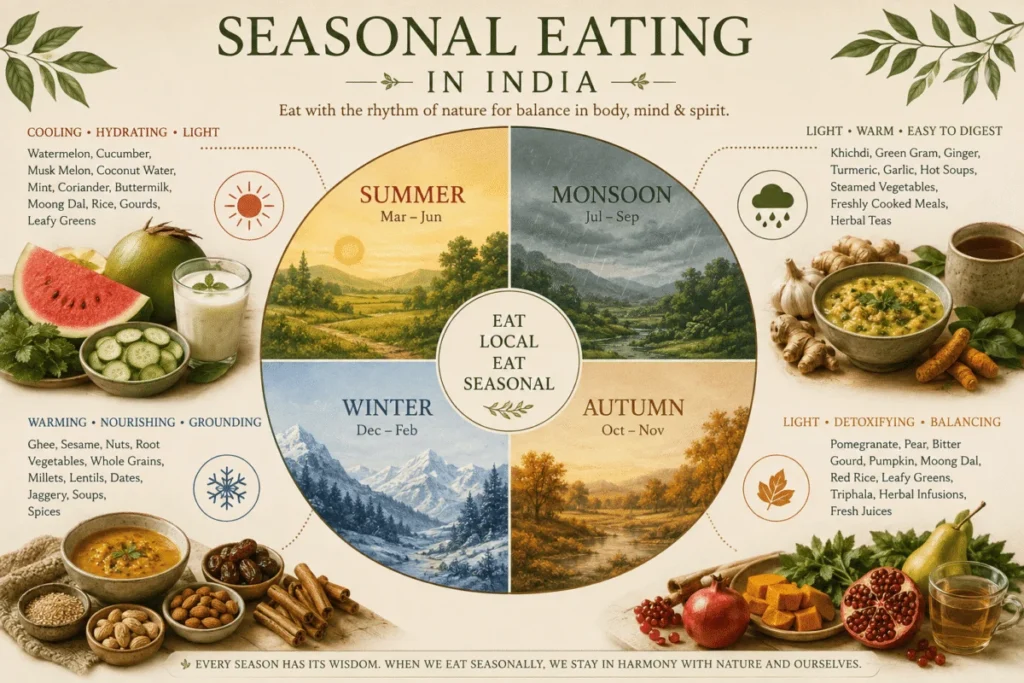
Seasonal eating can naturally introduce variety into your diet.
Different seasons bring different fruits, vegetables, grains and herbs to the kitchen. Eating a diverse range of plant foods is also an important part of a balanced diet.
There is another benefit.
Seasonal foods often work beautifully with the way we naturally eat.
Think about summer.
When temperatures rise, many people naturally prefer lighter meals, fresh fruits and cooling foods.
In winter, warm soups, cooked vegetables, dals and nourishing meals can feel much more satisfying.
The season can become a gentle guide rather than another set of dietary rules.
Summer: Keep It Light, Fresh & Hydrating
March–June
Indian summers can be intense, particularly across northern and central parts of the country.
As temperatures rise, hydration becomes especially important.
Build your summer plate around:
- Cucumber
- Watermelon
- Muskmelon
- Seasonal leafy vegetables
- Gourds
- Curd and buttermilk, where suitable
- Fresh herbs
- Lightly cooked vegetables
- Fruits with high water content
Traditional Indian summer foods such as sattu drinks, chaas and seasonal fruits can also be part of a balanced diet.
The Ayurvedic perspective
Ayurveda traditionally recommends adapting food and lifestyle according to the season. Summer is generally associated with a preference for lighter and more cooling choices.
Rather than interpreting this as a prescription for everyone, think of it as an invitation to observe:
Does your body feel better with lighter meals when the weather is hot?
Your experience matters.
Monsoon: Warm, Fresh & Mindful
June–September
The monsoon changes the environment dramatically.
Humidity rises, temperatures fluctuate and food hygiene becomes particularly important.
This is a good season to pay attention to fresh preparation, clean drinking water and proper food storage.
Bring more of these to your table:
- Warm cooked meals
- Seasonal vegetables
- Moong dal
- Light soups
- Ginger
- Cumin
- Coriander
- Turmeric
- Freshly prepared foods
Be thoughtful about foods that have been sitting outside for long periods, particularly during hot and humid weather.
A simple monsoon principle:
Freshly prepared food is your friend.
This doesn’t mean avoiding every raw food or fermented food. It simply means paying closer attention to freshness, hygiene and individual tolerance.
Autumn: A Time for Variety
September–November
As the heavy monsoon gradually gives way to clearer weather, the kitchen can begin to transition again.
This is a wonderful time to bring more variety to your plate.
Think:
- Seasonal vegetables
- Gourds
- Pumpkin
- Green leafy vegetables
- Fresh fruits
- Whole grains
- Pulses
- Herbs and spices
Instead of searching for a single “detox food,” focus on returning to a balanced eating pattern.
Your body doesn’t need an extreme cleanse after every season.
It needs consistent nourishment.
Winter: Warm, Nourishing & Satisfying
November–February
Winter is perhaps the easiest season to appreciate through food.
Indian winter kitchens naturally become richer in seasonal produce and warming dishes.
Think:
sarson, bathua, methi, carrots, peas, radish, beetroot, sweet potatoes, sesame, bajra and a variety of dals and whole grains.
Warm meals can be especially comforting during colder months.
Build your winter plate with:
- Seasonal vegetables
- Whole grains
- Dal and other protein-rich foods
- Nuts and seeds
- Sesame
- Warming spices
- Soups and stews
- Freshly cooked meals
Winter is also a beautiful time to enjoy traditional foods — while keeping portions and overall dietary balance in mind.
February–March
Spring brings another transition.
The weather begins to warm, fresh produce becomes abundant and eating patterns can naturally become lighter.
This is an ideal time to bring more:
- Fresh greens
- Seasonal fruits
- Lightly cooked vegetables
- Sprouts, if suitable for you
- Whole grains
- Pulses
- Fresh herbs
Spring doesn’t require a dramatic “detox.”
Instead, think freshness, variety and balance.
Your Indian Kitchen Already Knows the Seasons
One of the beautiful things about Indian food culture is that seasonal eating is already deeply woven into traditional kitchens.
From winter’s sarson ka saag and bajra roti to summer’s chaas, cucumber and seasonal melons, many regional food traditions naturally reflect the environment.
Our grandparents didn’t necessarily need an app telling them what was seasonal.
The local market told them.
The weather told them.
And tradition passed that knowledge from one generation to the next.
Modern life has made food available all year round.
That convenience is valuable — but it also means we can lose touch with seasonality.
Perhaps it’s time to reconnect.
A Simple Seasonal Plate Formula
You don’t need to redesign your entire diet every few months.
Start with this simple approach:
½ plate
Seasonal vegetables
¼ plate
Protein
Dal, beans, lentils, paneer, curd, eggs or other suitable sources.
¼ plate
Whole grains or other carbohydrate-rich foods
Rice, roti, millets, oats or other grains.
Then add:
Healthy fats + herbs + spices + seasonal fruit
The exact proportions can vary according to your individual needs.
The important thing is variety and balance.
What About Ayurveda and Doshas?
You may have heard that Ayurveda recommends different foods for Vata, Pitta and Kapha.
These concepts form an important part of Ayurvedic dietary philosophy.
However, dosha-based eating can become unnecessarily complicated when reduced to internet lists of “foods you can” and “foods you can’t.”
Your constitution is only one part of the picture.
Season, age, activity, digestion, climate, lifestyle and individual needs also matter.
So rather than asking:
“Is this food good for my dosha?”
A more useful question may be:
“Does this food, in this season and in this quantity, work well for me?”
Seasonal Eating Doesn’t Mean Eating Perfectly
You don’t need to eat only locally grown foods.
You don’t have to eliminate foods that aren’t technically seasonal.
And you certainly don’t need to feel guilty about enjoying an ice cream on a hot day or a favourite comfort food in winter.
Seasonal eating is not another rulebook.
It is a way of becoming more aware.
Notice what is available.
Notice what you enjoy.
Notice how your body responds.
Then make thoughtful choices more often.
A Simple Seasonal Eating Rhythm
Instead of changing everything overnight, try these five habits:
1. Shop seasonally.
Visit your local market and notice what’s naturally abundant.
2. Change your vegetables.
Don’t buy the same five vegetables every week.
3. Follow the weather.
Lighter foods may feel better in hot weather; warm, nourishing meals may be more satisfying in colder months.
4. Cook more often.
Home cooking makes it easier to control ingredients and adapt meals to the season.
5. Keep variety at the centre.
No single food needs to carry the responsibility for your health.
The Ananta Harmony Perspective
Seasonal eating is ultimately about something bigger than food.
It is about living in relationship with your environment.
Ayurveda has long encouraged awareness of seasonal changes. Modern nutrition reminds us of the importance of dietary variety, adequate nutrients and balanced eating patterns.
These ideas can coexist beautifully.
We don’t have to choose between tradition and modern life.
We can take the wisdom that still serves us, examine it thoughtfully, and bring it into our kitchens in a practical way.
So the next time the weather changes, look at your plate.
Ask yourself:
What is the season offering me?
What does my body seem to need?
And how can I make my next meal a little more nourishing?
You don’t need a complicated diet.
Sometimes, harmony begins with something as simple as eating what is fresh, nourishing and appropriate for the season.



[…] the year-round picture rather than this single season, see Seasonal Eating in India. To understand why sweet, bitter and astringent matter here, the Six Tastes guide covers the full […]