Ayurveda, translated for modern life

Sharad Ritu (शरद ऋतु): An Ayurvedic Autumn Reset
Autumn is when the heat stored through the monsoon finally surfaces. What to cook, what to ease off, and how to eat through festival season without paying for it.

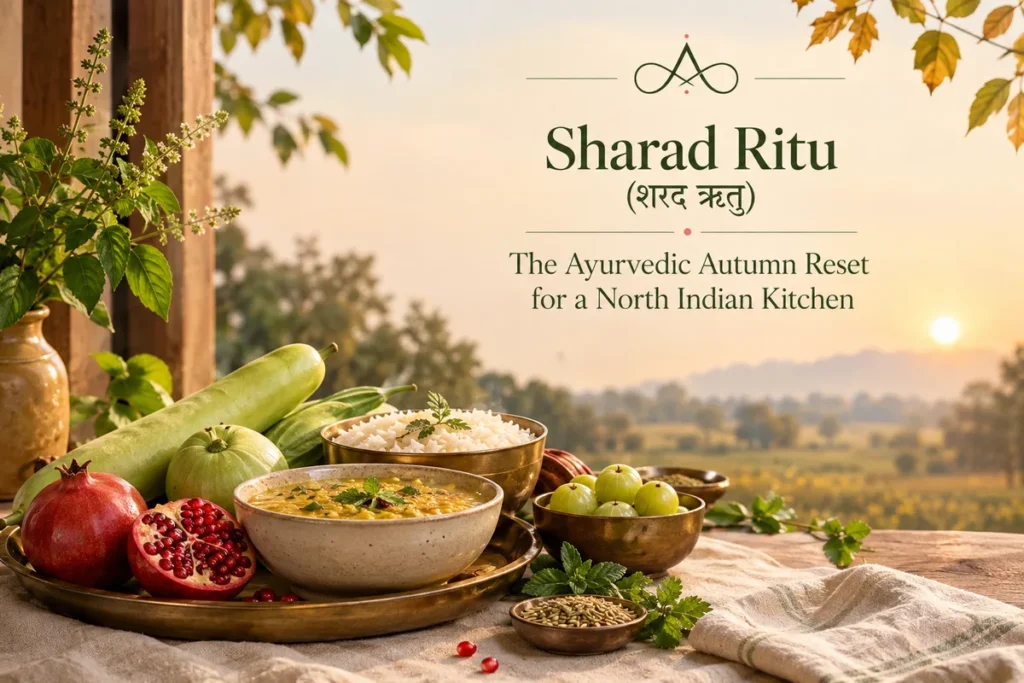
The monsoon is retreating, the skies are clearing, and the autumn sun feels stronger again. In Ayurveda, this transition is known as Sharad Ritu (शरद ऋतु)—a season traditionally associated with Pitta aggravation. Here is what Ayurveda says about autumn, and how you can bring that wisdom into an everyday North Indian kitchen.
There is something different about North India after the monsoon.
The heavy humidity begins to disappear. The skies become clearer. The sunlight feels sharper. Mornings become brighter, evenings more comfortable, and the festive season slowly begins.
But according to Ayurveda, this is more than just a change in weather.
It is a seasonal transition, and Ayurveda has a specific framework for living through it.
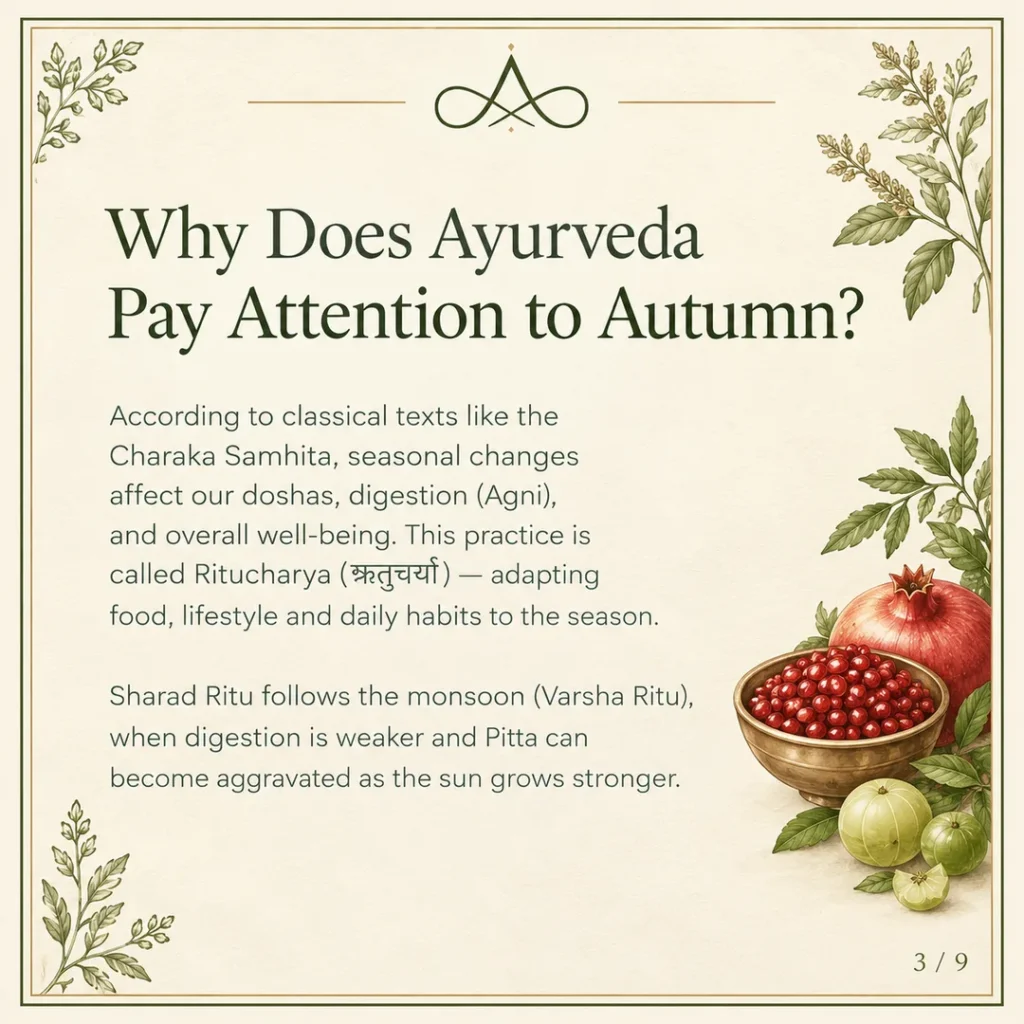
It is called Ritucharya (ऋतुचर्या)—the practice of adapting food, lifestyle and daily habits according to the season.
The period after the monsoon is known as Sharad Ritu (शरद ऋतु), or autumn.
And this is traditionally considered an important season for paying attention to Pitta (पित्त).
Why does Ayurveda pay special attention to autumn?
One of the central ideas in Ayurveda is that our bodies are constantly responding to the environment around us.
The Charaka Samhita, one of Ayurveda’s foundational texts, describes seasonal changes in relation to the doshas and recommends adapting diet and lifestyle as the seasons change.
This is the essence of Ritucharya (ऋतुचर्या).
Sharad Ritu follows Varsha Ritu (वर्षा ऋतु), the monsoon season.
During the rainy season, Ayurveda traditionally considers digestion—or Agni (अग्नि)—to be more vulnerable.
Then the rains retreat.
The sun becomes stronger.
The environment becomes warmer and clearer.
According to classical Ayurvedic understanding, Pitta that has accumulated during the preceding season can become aggravated during Sharad.
This is why autumn has a very different place in the Ayurvedic seasonal calendar.
It is not simply the end of summer.
It is a transition into a new physiological rhythm.
Pitta (पित्त): the dosha Ayurveda watches in Sharad
Pitta is one of Ayurveda’s three doshas:
Vata (वात) • Pitta (पित्त) • Kapha (कफ)
Pitta is associated with qualities such as heat, sharpness, transformation and metabolism.
When balanced, Pitta supports digestion, metabolism and transformation.
When aggravated, classical Ayurvedic descriptions associate excess Pitta with qualities of heat and irritation.
You may notice things such as:
- A feeling of excess heat
- Acidity or burning sensations
- Skin irritation or breakouts
- Red or irritated eyes
- Loose or unsettled digestion
- Increased irritability
- Sensitivity to heat
Of course, these symptoms can have many different causes.
They should not be used to diagnose a dosha imbalance.
Instead, Ayurveda encourages us to look for patterns.
If your digestion, skin or sense of heat tends to change around the same time every year, the seasonal framework gives you a useful way to observe that pattern.
The six tastes: Ayurveda’s way of balancing the season
One of the most practical ideas in Ayurveda is Rasa (रस), or taste.
Ayurveda describes six tastes:
Madhura (मधुर) — Sweet
Amla (अम्ल) — Sour
Lavana (लवण) — Salty
Katu (कटु) — Pungent
Tikta (तिक्त) — Bitter
Kashaya (कषाय) — Astringent
According to classical Ayurvedic principles, sweet, bitter and astringent tastes are traditionally considered Pitta-pacifying, while sour, salty and pungent tastes can increase Pitta.
And this is where the idea becomes wonderfully practical.
You don’t necessarily need to buy special Ayurvedic products.
Look at your own kitchen.
A North Indian autumn plate already contains many foods that fit beautifully into this seasonal approach.
What to eat during Sharad Ritu
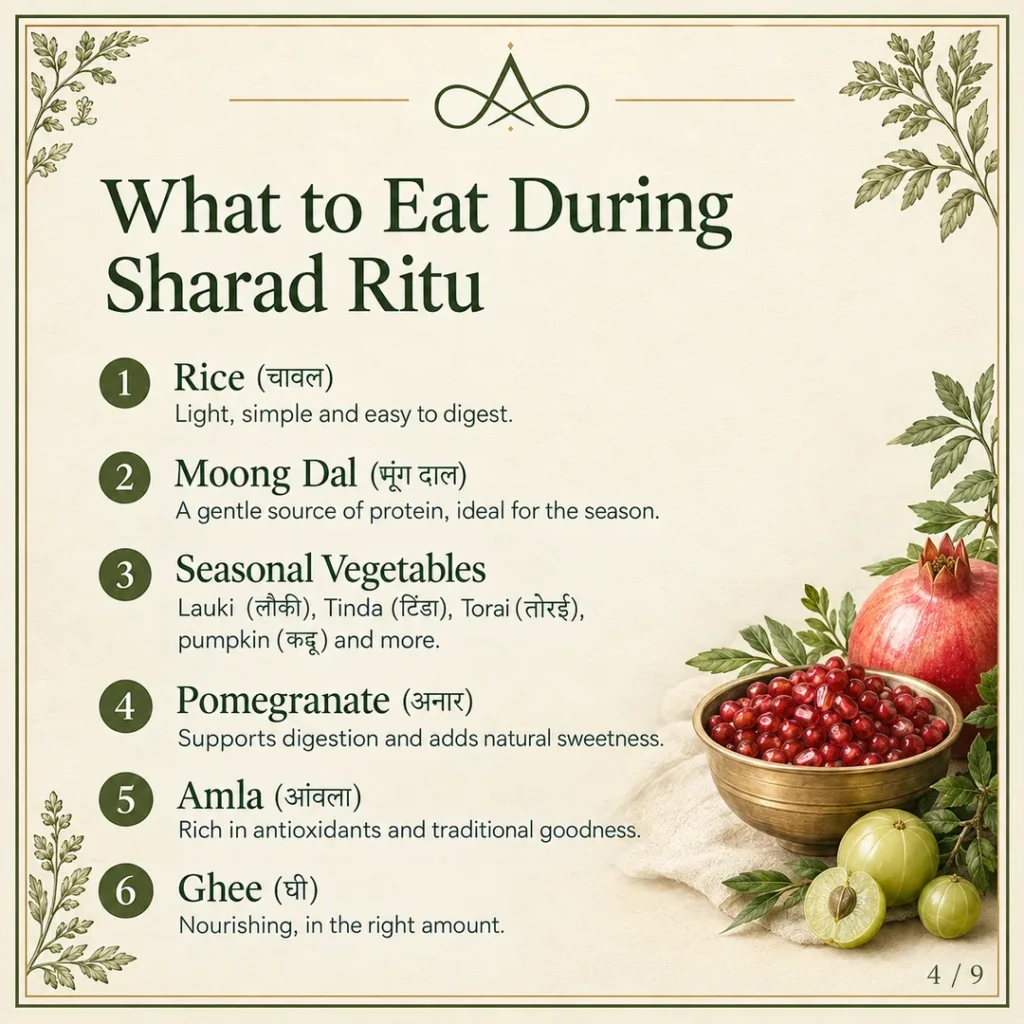
1. Rice (चावल)
Classical Ayurvedic texts mention Shali rice (शालि चावल) among foods suitable in seasonal dietary recommendations.
For a modern North Indian kitchen, rice can be paired with moong dal, seasonal vegetables and a little ghee to create a simple and nourishing meal.
Think:
Chawal + Moong Dal + Sabzi + a little Ghee
Simple food doesn’t have to be boring.
2. Moong Dal (मूंग दाल)
Mudga (मुद्ग), commonly associated with green gram or moong, is repeatedly valued in classical Ayurvedic dietary discussions for its relatively light and digestible nature.
That makes moong dal (मूंग दाल) a wonderful everyday staple.
You can prepare:
- Moong dal
- Moong khichdi (मूंग खिचड़ी)
- Moong chilla (मूंग चीला)
- Light moong soup
Keep the preparation gentle rather than making every meal heavily spiced.
3. Lauki (लौकी), Tinda (टिंडा) and Torai (तुरई)
This is where seasonal eating becomes beautifully simple.
You don’t need imported “superfoods”.
Look at what is growing around you and what is naturally available in your local sabzi mandi.
Lauki (लौकी)
Tinda (टिंडा)
Torai (तुरई)
Pumpkin (कद्दू)
These vegetables can be cooked gently with modest amounts of spices and paired with rice, dal or roti.
The idea is not to create a complicated Ayurvedic recipe.
It is to make your everyday food more appropriate for the season.
4. Pomegranate (अनार)
Dadima (दाडिम), or pomegranate, has an important place in classical Ayurvedic dietary discussions.
And from a North Indian perspective, it is also one of the easiest seasonal foods to enjoy.
Add fresh anar (अनार) to breakfast, enjoy it as a fruit, or use the seeds in suitable preparations.
Sometimes seasonal eating is this simple.
5. Amla (आंवला)
As autumn progresses, Amla (आंवला) begins appearing more widely.
Ayurveda gives amla a special place among traditional foods and formulations.
You may enjoy fresh amla when available or use traditional preparations appropriately.
But remember an important Ayurvedic principle:
The right food depends on the person, the preparation and the digestive capacity—not just the ingredient itself.
6. Ghee (घी)
Ghee is one of those foods where traditional wisdom and modern nutrition need to be understood separately.
In Ayurveda, Ghrita (घृत) is traditionally considered nourishing and is used in a variety of preparations.
In modern nutrition, ghee is a concentrated source of fat and saturated fatty acids.
So there is no need to fear it—and no need to turn it into a “superfood”.
A small amount used appropriately with a warm meal is very different from consuming large quantities simply because something is labelled Ayurvedic.
Use it mindfully.
What about spices?
Sharad Ritu does not mean giving up flavour.
It means being mindful of excessive heat.
Your kitchen can lean towards gentler flavours such as:
Dhaniya (धनिया) — Coriander
Saunf (सौंफ) — Fennel
Pudina (पुदीना) — Mint
Jeera (जीरा) — Cumin
At the same time, if you are experiencing heat or acidity, you may want to reduce very spicy preparations and excessive use of pungent ingredients.
The goal is not bland food.
The goal is balance.
What Ayurveda suggests reducing
Classical Sharad Ritu guidance recommends reducing foods and habits considered excessively heating or aggravating to Pitta.
That can translate into:
- Excessively spicy food
- Very sour foods
- Excess salt
- Heavy fried foods
- Excess alcohol
- Very late nights
- Daytime sleeping
This doesn’t mean that a pickle, pakora or piece of mithai has suddenly become “bad”.
Ayurveda is much more nuanced than that.
It considers:
quantity + frequency + preparation + digestion + constitution + season
rather than putting every food into a permanent good-or-bad category.
Curd (दही): one classical recommendation worth knowing
Curd is particularly interesting during Sharad Ritu.
Classical Ayurvedic texts discuss Dadhi (दधि)—curd—and its properties in considerable detail.
Traditional seasonal guidance recommends avoiding curd during Sharad, particularly in contexts where it may aggravate Pitta or Kapha.
But let’s make an important distinction.
This is a classical Ayurvedic recommendation, not a modern scientific finding that “curd becomes harmful in autumn.”
Modern nutrition does not establish such a seasonal rule.
So at Ananta Harmony, we prefer to say exactly what the evidence allows:
Ayurveda recommends it. Modern science has not established the same seasonal mechanism.
That distinction allows us to respect traditional knowledge without presenting tradition as clinical proof.
Sharad Ritu meets the North Indian festival season
There is one obvious problem.
Sharad Ritu arrives alongside:
Navratri • Dussehra • Karwa Chauth • Diwali
And our kitchens respond with:
Mathri (मठरी) • Namkeen (नमकीन) • Pakora (पकौड़ा) • Mithai (मिठाई) • Fried snacks
We are not going to tell you to stop celebrating.
Food is culture.
Food is family.
Food is memory.
Instead, make your choices more conscious.
Before the celebration
Don’t starve yourself all day to “save calories” for dinner.
Arriving extremely hungry makes overeating much easier.
During the celebration
Enjoy what you actually want.
Take a reasonable portion.
Eat slowly.
And notice when you have had enough.
After the celebration
Don’t punish yourself with a juice cleanse.
Don’t skip meals because you ate mithai.
Simply return to normal food.
Moong dal + rice + cooked vegetable + a little ghee.
Sometimes the best reset is simply going back to ordinary food.
What about Navratri fasting?
Navratri fasting deserves a little nuance.
Fasting practices differ greatly from one household to another.
Some people eat fruits and light meals.
Others eat sabudana, kuttu, singhara, potatoes and fried foods.
From an Ayurvedic perspective, fasting is not automatically beneficial simply because it is called a fast.
A week of deep-fried sabudana vada and potato dishes may be very different from a simple, appropriately planned fasting routine.
If you fast, focus on:
- Adequate hydration
- Simple preparation
- Appropriate portions
- Listening to your digestion
- Avoiding unnecessary overeating during the permitted meals
And if you have a medical condition, take medication, are pregnant, or have specific nutritional needs, fasting should be discussed with an appropriate healthcare professional.
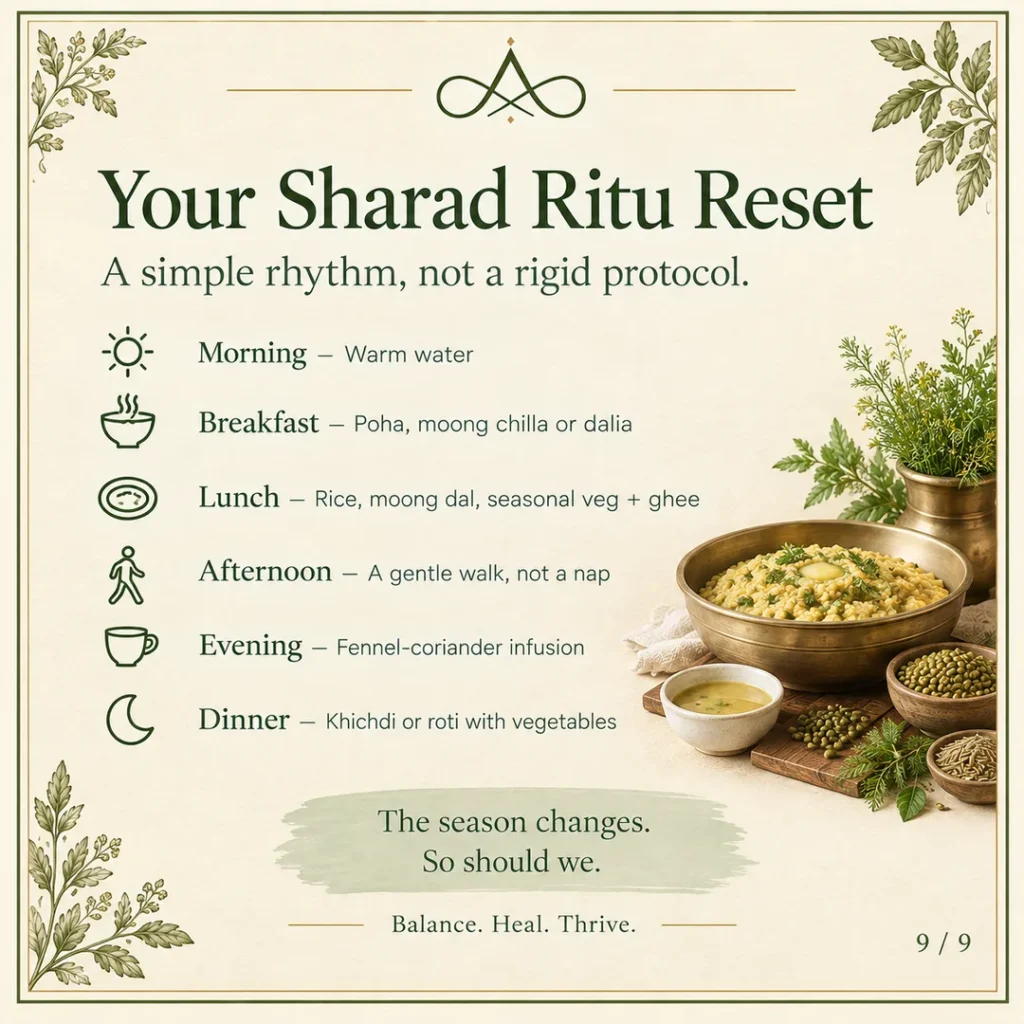
A simple Sharad Ritu day
Think of this as a rhythm, not a rigid protocol.
Morning — सुबह
Start your day with comfortable-temperature water.
Not boiling hot.
Not ice cold.
Just simple.
Breakfast — नाश्ता
Choose something cooked and easy to digest:
- Poha (पोहा)
- Moong chilla (मूंग चीला)
- Light dalia (दलिया)
- Another simple cooked breakfast
Lunch — दोपहर का भोजन
Traditionally, lunch is the more substantial meal.
A simple plate could be:
Rice (चावल)
+
Moong dal (मूंग दाल)
+
Lauki / Tinda / Torai (लौकी / टिंडा / तुरई)
+
A little ghee (घी)
Eat slowly and without rushing.
Afternoon — दोपहर के बाद
Instead of immediately sleeping, take a gentle walk.
Classical Ayurvedic seasonal guidance discourages daytime sleeping during Sharad.
Evening — शाम
Keep things simple.
A mild saunf-dhaniya infusion (सौंफ-धनिया) can be a pleasant option if it suits you.
Dinner — रात का भोजन
Make dinner lighter than lunch.
Think:
Khichdi (खिचड़ी)
or
Roti + cooked vegetable
Keep late-night heavy meals to a minimum.
What the classical Ayurvedic texts say
The concept of seasonal living is deeply rooted in Ayurveda.
It is not a modern wellness trend.
Charaka Samhita — चरक संहिता
In Sutrasthana, Chapter 6 — Tasyashitiya Adhyaya, Charaka discusses seasonal changes and appropriate dietary and lifestyle practices.
The chapter forms an important classical foundation for Ritucharya (ऋतुचर्या).
Sushruta Samhita — सुश्रुत संहिता
The Sushruta Samhita gives specific guidance for Sharad Ritu (शरद ऋतु).
It discusses suitable foods and recommends emphasis on sweet, bitter and astringent tastes, while advising moderation of foods and habits considered aggravating to Pitta.
Ashtanga Hridaya — अष्टांग हृदय
The Ashtanga Hridaya also presents seasonal regimens as part of Ayurvedic preventive living.
Together, these classical sources demonstrate an important Ayurvedic principle:
We should not eat and live exactly the same way throughout the year.
The environment changes.
Our needs change.
Our routines can change too.
And what does modern science say?
This is where we want to be particularly honest.
Modern research has not tested the complete Ayurvedic Sharad Ritu regimen as one intervention.
Therefore, we should not say that every classical seasonal recommendation has been scientifically proven.
Some broader principles are supported by modern research:
- Consistent sleep supports health.
- Regular meal timing may support metabolic health.
- A diverse plant-rich diet is beneficial.
- Excessive intake of highly processed and deep-fried foods is generally undesirable.
- Circadian rhythms influence metabolism and physiology.
But the specific Ayurvedic explanation of Pitta aggravation in Sharad remains a traditional Ayurvedic framework, rather than an established modern physiological mechanism.
And that distinction is important.
We can appreciate Ayurveda without pretending that every classical explanation has already been proven by modern science.
What about an Ayurvedic cleanse?
You may see many “autumn detox” programs online.
This is where we recommend caution.
Classical Ayurveda describes Virechana (विरेचन), a therapeutic purgation procedure, in specific clinical contexts.
Virechana is not:
- A juice cleanse
- A detox tea
- A laxative challenge
- A seven-day social-media detox
- Something to attempt from a blog post
It is a therapeutic Ayurvedic procedure that requires appropriate assessment and supervision.
Your body does not need to be punished because the season changed.
Your simple Sharad Ritu plate
If you remember nothing else from this article, remember this:
You don’t need a cupboard full of Ayurvedic products.
Start with your ordinary kitchen.
A simple autumn plate could be:
चावल — Rice
मूंग दाल — Moong dal
लौकी / टिंडा / तुरई — Seasonal vegetables
घी — Ghee, in an appropriate amount
अनार — Pomegranate
Warm.
Simple.
Seasonal.
Comfortable.
That is often where Ayurvedic wisdom becomes most practical.
But Ayurveda doesn’t have one diet for everyone
This is perhaps the most important point.
Ayurveda considers Prakriti (प्रकृति)—your individual constitution—and also considers your current state, digestion, age, activity, environment and season.
Someone with a strong Pitta tendency may experience Sharad differently from someone whose constitution is predominantly Vata or Kapha.
Even your Agni (अग्नि)—digestive capacity—can change with the seasons.
So seasonal eating should never become another rigid food chart.
Instead, ask yourself:
How do I feel after this meal?
Is my digestion comfortable?
Do I feel excessively hot, heavy, dry or sluggish?
What foods are naturally available around me right now?
Does this food suit me, or am I eating it simply because someone called it healthy?
These questions bring Ayurveda into real life.
Your Sharad Ritu reset
You don’t need to change everything at once.
Start with three things:
1. Make dinner lighter.
2. Eat more seasonal, cooked foods.
3. Reduce excess heat—very spicy food, deep-fried meals, overeating and late nights.
Then observe.
Not obsessively.
Just observe.
Because seasonal living is not about following a perfect diet.
It is about creating a better relationship between your body, your food, your environment and the season you are living through.
The season changes.
And Ayurveda teaches us that perhaps we should change with it.
That is Ritucharya.
That is seasonal harmony.
That is the Ananta Harmony way.
Balance. Heal. Thrive.
Where to go next
If you are not sure which constitution you lean towards, the Prakriti Check is a reasonable starting point, and the Doshas page explains what the three actually describe.
For the year-round picture rather than this single season, see Seasonal Eating in India. To understand why sweet, bitter and astringent matter here, the Six Tastes guide covers the full framework.
For how the timings in this article fit into an ordinary day, our Daily Rhythm page walks through it hour by hour.
If you would like guidance shaped around your own constitution rather than a general seasonal framework, Dr. Arun offers consultations.
Classical Ayurvedic References
- Charaka Samhita (चरक संहिता) — Sutrasthana 6, Tasyashitiya Adhyaya — seasonal regimen and Ritucharya.
- Sushruta Samhita (सुश्रुत संहिता) — Sutrasthana 46 — properties and effects of foods including Mudga, Dadima and Amalaki.
- Sushruta Samhita (सुश्रुत संहिता) — Uttara Tantra 64 — guidance relating to Sharad Ritu.
- Charaka Samhita (चरक संहिता) — Sutrasthana 26 — discussion of Rasa (रस), the six tastes, and their relationship with the doshas.
- Ashtanga Hridaya (अष्टांग हृदय) — Sutrasthana — seasonal regimen and Ritucharya.
A note from Ananta Harmony
This article presents classical Ayurvedic concepts for educational purposes. Traditional Ayurvedic recommendations should not be considered a diagnosis or individualized medical treatment. If you have persistent, severe or new symptoms, please consult an appropriately qualified healthcare professional.