Ayurveda, translated for modern life

Why Ayurveda puts your biggest meal at noon, and what modern research says
The classical rule and the chronobiology research point the same way. Here is where they agree, and where they do not.

Ayurveda says your digestive fire peaks at midday, so that is when your largest meal belongs. Modern chronobiology arrives at a strikingly similar conclusion by an entirely different route.
Most of us eat the other way round.
A rushed breakfast. A sandwich at the desk. Then the real meal at eight or nine at night, often in front of a screen.
It is worth asking why the classical texts insist on the reverse — and whether there is anything behind it beyond tradition.
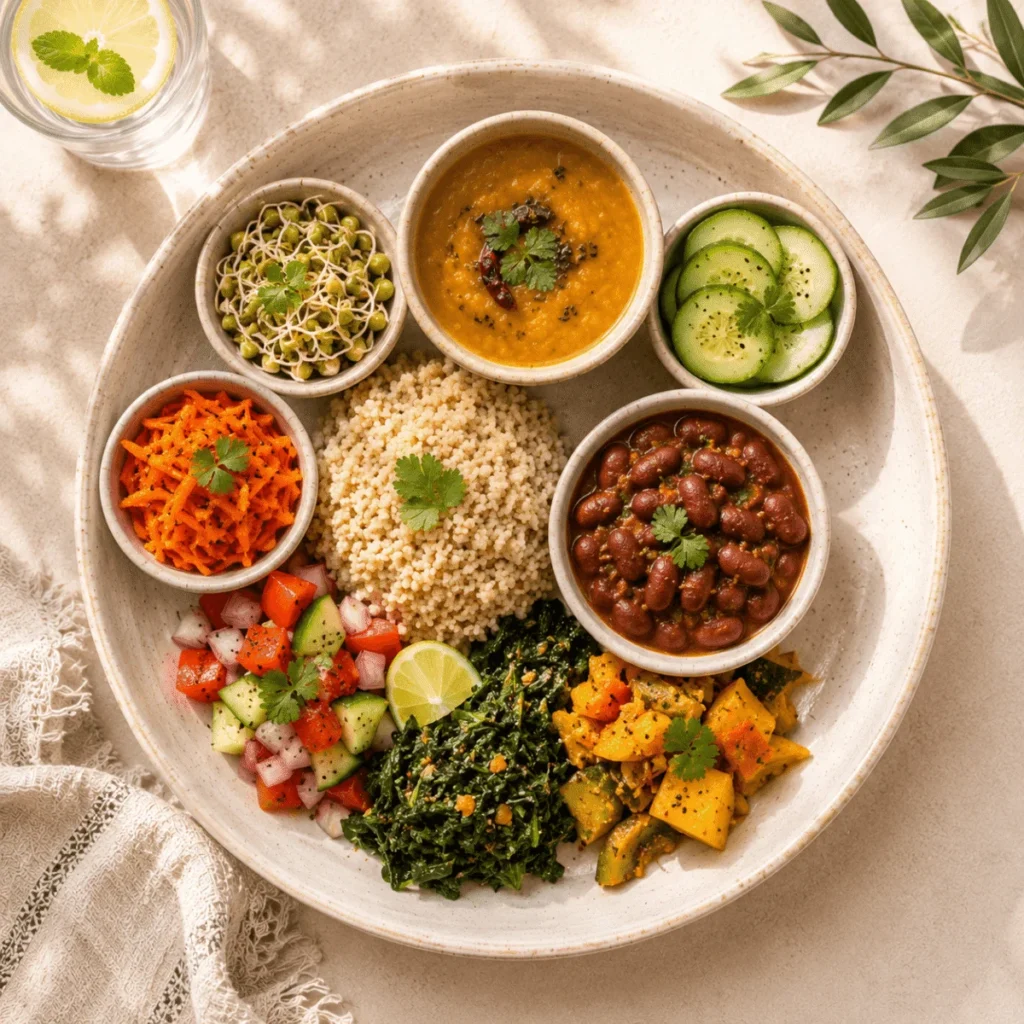
What the Pitta Hours Actually Are
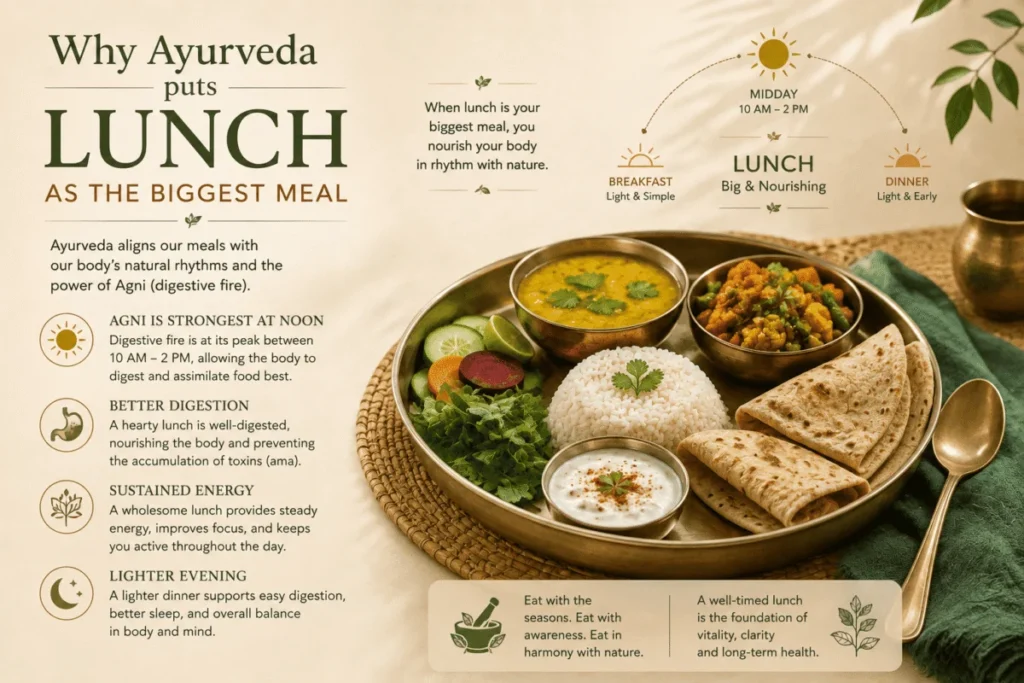
Ayurveda divides the day into six windows of roughly four hours each.
The window running from mid-morning to mid-afternoon belongs to Pitta — the principle of transformation, heat and digestion.
This is when agni, the digestive fire, is considered strongest.
The modern parallel
Body temperature, digestive enzyme activity and insulin sensitivity all follow a daily rhythm that peaks around midday and tapers through the evening.
This is not an Ayurvedic invention. Chronobiology — the study of the body’s internal clocks — describes the same curve using entirely different language.
Two traditions, separated by a few thousand years, pointing at the same window.
What the Research Actually Shows
Studies on meal timing, sometimes called chrononutrition, have found a consistent pattern.
People who eat a larger share of their daily calories earlier tend to show better markers of metabolic health:
- Improved glucose tolerance
- More stable insulin response
- Easier weight management in some trials, even when total daily intake is matched
Where the evidence stops
The effect is consistent enough to take seriously.
It is not the same as proof that a noon meal specifically improves digestion, and no single study settles the question.
What the research supports is a general direction: earlier and larger beats later and larger, for how your body processes food.
What This Looks Like in Practice
You do not need to reorganise your whole day to test this.
Four small shifts
- Make lunch the meal you plan, not the one you grab
- Let dinner be smaller and simpler — soup, khichdi, something cooked rather than composed
- Eat dinner earlier where your schedule allows, ideally two or three hours before bed
- Start with two days a week rather than attempting every day at once
What people notice first
The shift people report first is usually not digestive. It is sleep.
A lighter, earlier dinner tends to mean falling asleep faster and waking less foggy.
That makes sense given how much of the body’s repair work happens overnight — and how much energy digestion itself demands.
Who Should Be Cautious
Meal timing is not something to change on the strength of a blog post if any of the following apply to you:
- You are pregnant
- You are managing diabetes
- You take medication with specific food-timing requirements
- You have a history of disordered eating
In these cases, talk to your doctor first.
For most people without those constraints, this is a low-risk experiment with genuine research behind the general direction, even if the finer details are still being worked out.
The Takeaway
Ayurveda and modern chronobiology rarely line up this neatly.
When a five-thousand-year-old observation and a contemporary research field point at the same four-hour window, that is worth paying attention to — without overstating what either one has proven.
Move your largest meal to the middle of the day, two days this week, and notice what changes.