Ayurveda, translated for modern life

Painful Periods: The Ayurvedic View and What Ancient Wisdom Says
Ayurveda reads period pain as disturbed Apana Vata, not as something to endure. What Artava, Agni and the classical description of Udavartini Yonivyapad actually say, and eight practical shifts for the days you bleed.


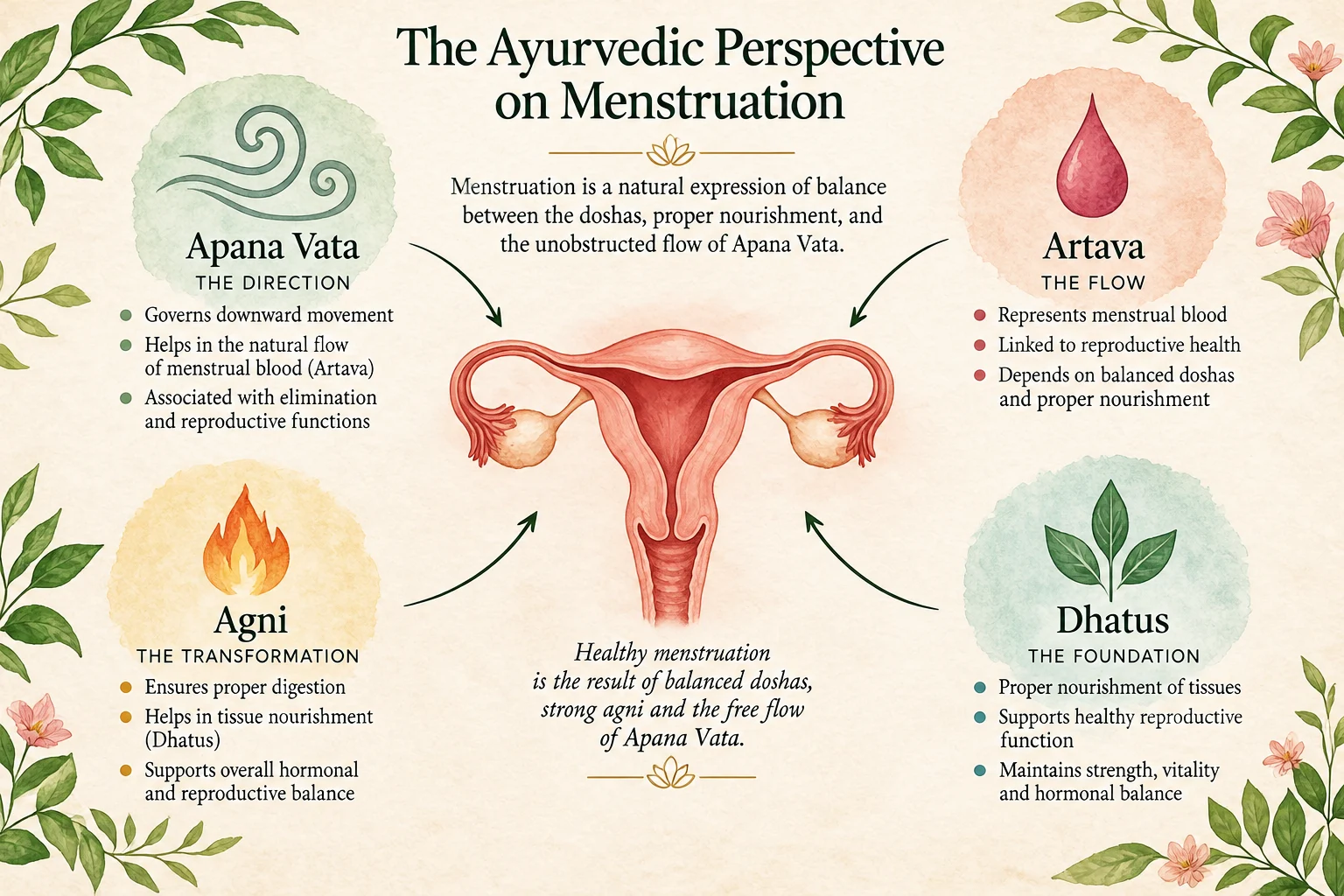
Menstruation is not described in Ayurveda merely as a monthly event. It is connected with Artava (आर्तव), Agni (अग्नि), Dosha balance, nourishment of the Dhatus, and particularly the proper movement of Apana Vata (अपान वायु).
When menstruation becomes painful, Ayurveda therefore asks a deeper question:
What is disturbing the natural flow of the body?
Classical Ayurvedic texts such as the Charaka Samhita, Sushruta Samhita and Ashtanga Hridaya contain extensive discussions of women’s reproductive health under concepts including Artava and Yonivyapad (योनि व्यापद).
Among these descriptions, painful menstruation is strongly associated with disturbance of Vata Dosha.
And this gives us one of Ayurveda’s most important principles for understanding period pain:
Where there is pain, Vata is usually involved.
First, Understand Artava
In Ayurvedic literature, Artava is a broader reproductive concept, although in the context of menstruation it is commonly used in relation to menstrual blood and female reproductive physiology.
Healthy menstruation depends upon much more than the uterus alone.
Ayurveda views the body as an interconnected system.
The quality of nourishment, digestion, tissue metabolism, Dosha balance and the movement of Vata all influence reproductive health.
This is why Ayurveda rarely looks at painful periods as an isolated problem.
It looks at the woman as a whole.
Apana Vata: The Ayurvedic Key to Menstruation
Of all the Ayurvedic concepts surrounding menstruation, Apana Vata is perhaps the most important.
Vata is traditionally described through five functional divisions:
Prana Vata
Udana Vata
Samana Vata
Vyana Vata
Apana Vata
Apana Vata resides predominantly in the lower region of the body and governs downward-moving functions.
Its natural direction is downward — Anuloma Gati (अनुलोम गति).
It is traditionally associated with the elimination of stool and urine, menstruation, reproductive functions and childbirth.
During menstruation, the natural downward movement of Apana Vata supports the elimination of menstrual flow.
When this movement occurs normally, menstruation should happen without excessive obstruction.
But when Vata becomes disturbed, obstructed or begins moving abnormally, discomfort may arise.
Why Ayurveda Connects Pain With Vata
Ayurveda describes Vata as possessing qualities such as:
Ruksha (रूक्ष) — dry
Sheeta (शीत) — cold
Laghu (लघु) — light
Chala (चल) — mobile
Khara (खर) — rough
Sukshma (सूक्ष्म) — subtle
Pain—Shoola (शूल)—is particularly associated with Vata disturbance in Ayurvedic reasoning.
This is why cramping, pulling sensations, spasmodic pain, lower abdominal discomfort and pain extending towards the back or thighs are traditionally examined through the state of Vata.
But Ayurveda goes further.
The question isn’t simply:
“Is Vata high?”
The practitioner considers why Vata has become disturbed and whether its normal pathway has been obstructed.
That distinction matters.
Udavartini Yonivyapad: An Important Classical Description
One of the most relevant classical concepts when discussing painful menstruation is:
Udavartini Yonivyapad
उदावर्तिनी योनिव्यापद
Charaka Samhita discusses Udavartini among disorders affecting female reproductive health.
In this condition, disturbed Vata moves contrary to its natural direction and interferes with the normal downward movement of menstrual flow.
A particularly interesting feature of the classical description is that pain occurs around menstruation and relief may follow the proper discharge of menstrual blood.
From an Ayurvedic perspective, this gives us an important clue:
Healthy menstruation depends upon unobstructed downward movement.
The aim, therefore, is not simply to suppress pain.
The deeper Ayurvedic approach is to restore the appropriate movement of Apana Vata.
What Disturbs Apana Vata?
Ayurveda pays enormous attention to daily habits.
A woman’s menstrual experience cannot always be separated from what happens during the rest of the month.
Vata may become disturbed through patterns dominated by its own qualities—particularly excessive dryness, coldness, irregularity and depletion.
Examples traditionally consistent with Vata-aggravating living include:
Irregular meals
Frequently skipping meals or eating at unpredictable times can disturb the body’s natural rhythm.
Excessive fasting
Constant restriction or inadequate nourishment can increase Ruksha and Laghu qualities.
Dry and very light foods
A diet dominated by dry, rough foods may further aggravate Vata in susceptible individuals.
Excessive cold
Cold foods, drinks and environments are traditionally considered aggravating when Vata is already elevated.
Overexertion
Too much physical activity without adequate nourishment and recovery may contribute to depletion.
Insufficient rest
Constant activity without periods of restoration is contrary to the grounding qualities traditionally used to pacify Vata.
Suppression of natural urges
Ayurveda gives particular importance to Vega Dharana (वेग धारण)—habitually suppressing natural bodily urges.
The ancient texts repeatedly caution against interfering with the body’s natural eliminative impulses.
Your Bowels and Your Period Are Not Completely Separate in Ayurveda
This is one of the most beautiful examples of Ayurveda looking at the body as an interconnected system.
Apana Vata is associated not only with menstruation but also with defecation and other downward-moving functions.
Therefore, when assessing menstrual discomfort, an Ayurvedic practitioner may also ask:
Are you constipated?
Are stools hard and dry?
Do you strain?
Is there excessive gas?
Does your abdomen feel tight or bloated?
Do you regularly suppress the urge to pass stool or urine?
This is why supporting proper elimination is an important part of maintaining balanced Apana Vata.
Ayurveda doesn’t necessarily treat the menstrual cycle as something completely separate from digestion.
Agni Matters Too
You cannot understand reproductive health in Ayurveda without understanding Agni (अग्नि).
Agni represents the body’s transformative and digestive capacity.
Food must first be properly digested and assimilated before it can adequately nourish the tissues.
Ayurvedic physiology describes progressive nourishment through the Dhatus (धातु).
When digestion is disturbed for long periods, nourishment of the tissues may also become disturbed.
Therefore, when menstrual problems appear repeatedly, Ayurveda traditionally looks beyond the reproductive organs.
It asks:
How is your appetite?
How well are you digesting food?
Do you feel heavy after eating?
Are you frequently bloated?
Are your bowel movements regular?
The menstrual cycle can tell us something about the broader state of nourishment and balance within the body.
The Ayurvedic Approach During Painful Periods
The Ayurvedic principle is beautifully simple:
Do not create more Vata when Vata is already disturbed.
Instead, introduce qualities traditionally considered opposite to aggravated Vata:
Warmth instead of excessive cold.
Moisture and unctuousness instead of excessive dryness.
Regularity instead of chaos.
Rest instead of overexertion.
Nourishment instead of unnecessary restriction.
Gentleness instead of force.
1. Choose Warm, Freshly Prepared Food
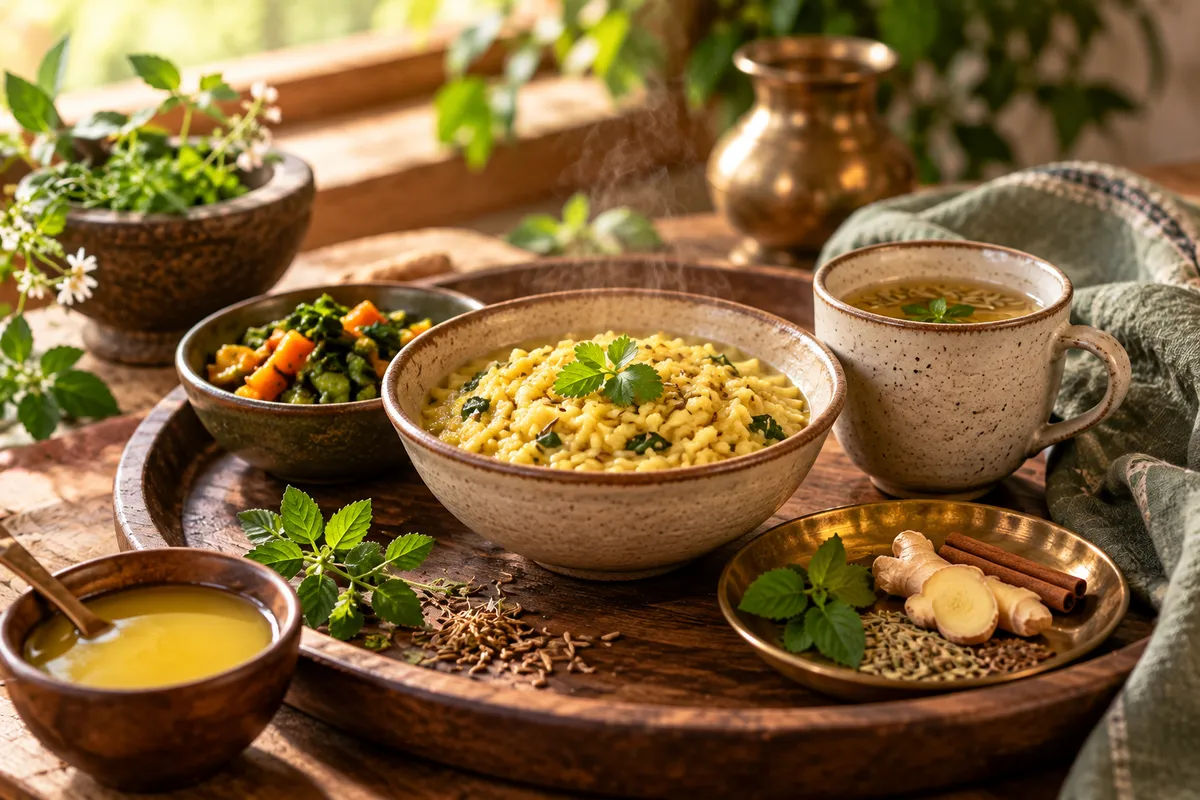
During menstruation—especially when there is cramping, dryness or digestive sensitivity—Ayurvedic wisdom generally favours food that is:
Ushna — warm
Snigdha — appropriately unctuous
Laghu — easy to digest, where needed
Freshly prepared
Simple meals may include:
Moong dal khichdi
Soft rice and dal
Warm vegetable preparations
Daliya
Light soups
Well-cooked seasonal vegetables
A little ghee when suitable
The goal is not to eat as little as possible.
It is to make nourishment easy for Agni to process.
2. Don’t Turn Your Period Into a Detox
Fasting and aggressive cleansing have become popular wellness trends.
But menstruation is already a naturally occurring physiological process.
From an Ayurvedic perspective, someone experiencing Vata-type menstrual discomfort may not benefit from adding further Langhana—lightening or reducing measures—without proper indication.
If the body already feels cold, dry, depleted, weak or painful, excessive fasting may introduce exactly the qualities Ayurveda is trying to balance.
Sometimes the wiser practice is simply:
eat properly, rest properly and allow the body’s natural process to occur.
3. Warmth Is One of Vata’s Simplest Opposites
Because Vata carries the quality of Sheeta—coldness, warmth has traditionally been used as one of the balancing qualities.
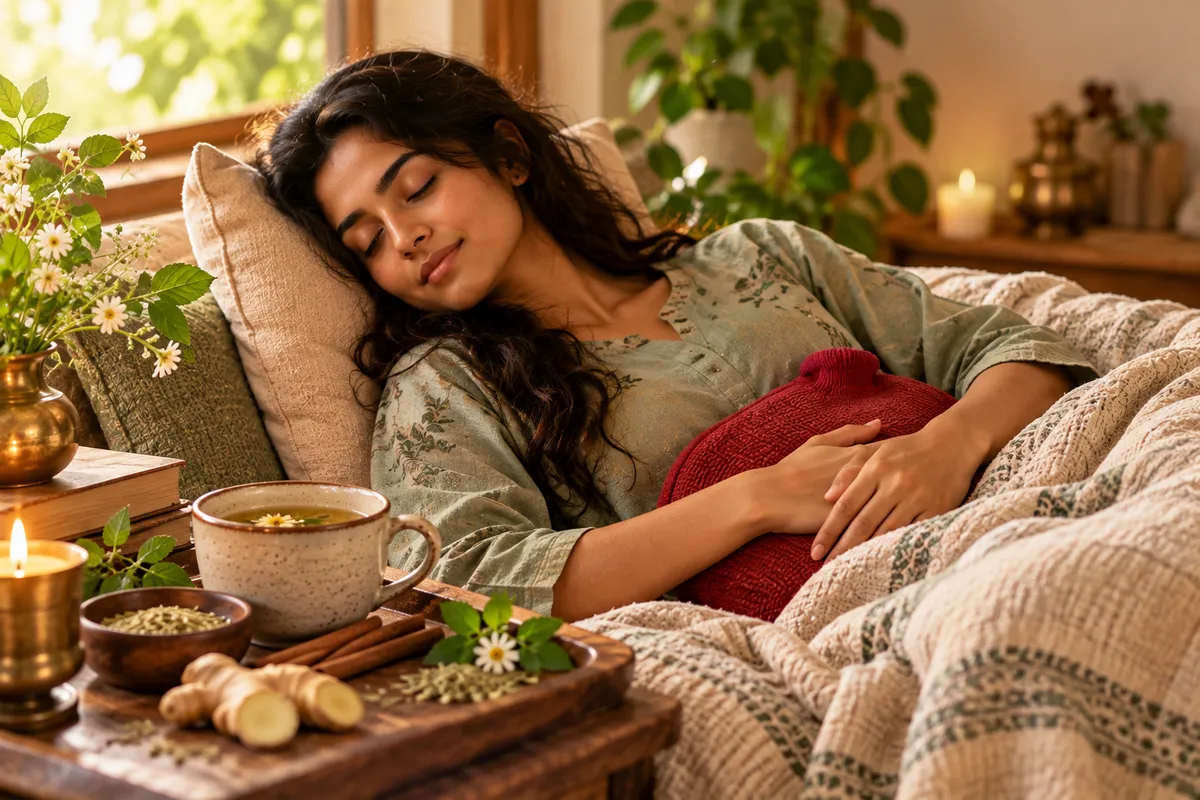
Gentle warmth around the lower abdomen or lower back can therefore fit naturally within a Vata-pacifying approach.
Warm food, warm bathing and protection from excessive cold may also feel supportive during menstruation.
The principle is not complicated:
Cold contracts. Warmth softens.
Ayurveda often works through these simple relationships between opposing qualities.
4. Sneha: More Than Just Oil
One of Ayurveda’s beautiful concepts is Sneha (स्नेह).
Sneha can refer to oiliness or unctuousness, but the Sanskrit word also carries associations with affection and tenderness.
Vata is dry and rough.
Sneha introduces softness and lubrication.
This is one reason Abhyanga—oil massage—is traditionally valued in Vata management.
A regular gentle Abhyanga practice outside the most uncomfortable days of menstruation may be incorporated into a broader Vata-balancing routine when appropriate for the individual.
The deeper principle is not simply:
“Use oil for period pain.”
It is:
Bring Snigdha qualities into a system dominated by Ruksha qualities.
5. Respect Apana’s Downward Direction
During menstruation, Ayurveda traditionally encourages respecting the body’s natural downward movement.
This means avoiding unnecessary suppression of natural urges and reducing excessive strain.
Menstruation itself can be understood as a time when Apana is actively performing its natural function.
Instead of forcing the body to behave exactly as it does every other day, Ayurveda encourages observation.
Slow down where needed.
Rest when tired.
Eat when genuinely hungry.
Allow natural elimination.
Create rhythm.
The intention is to support Apana rather than disturb it.
Menstruation as a Monthly Reflection
One of the deeper lessons we can take from Ayurveda is that menstruation does not begin on the first day of bleeding.
Your menstrual experience may reflect patterns that have been developing throughout the month.
Irregular eating.
Poor digestion.
Constipation.
Overwork.
Inadequate rest.
Excessive fasting.
Poor nourishment.
Continually ignoring natural bodily signals.
These patterns do not suddenly disappear when menstruation arrives.
This is why Ayurveda emphasizes Dinacharya—daily routine.
The health of the cycle is supported every day, not only when cramps begin.
Ritucharya Matters Too
Ayurveda also recognizes that the body changes with the seasons.
This is the principle of Ritucharya (ऋतुचर्या).
Different seasons influence Doshas differently, which means diet and lifestyle should not remain exactly the same throughout the year.
Someone already experiencing dryness and Vata-type menstrual discomfort may require particular attention during seasons and environmental conditions that further increase Vata qualities.
This is another reason Ayurveda avoids universal wellness routines.
The same woman may need different support at different times of the year.
Not Every Woman Needs the Same Remedy
This is where authentic Ayurveda differs greatly from social-media Ayurveda.
One woman may experience:
Dryness + constipation + cramping + scanty flow.
Another may experience:
Heat + irritability + burning sensations + heavier flow.
Another may experience:
Heaviness + sluggishness + congestion.
All three may say:
“I have painful periods.”
But Ayurveda does not necessarily see them as the same condition.
Prakriti, Vikriti, Agni, bowel habits, strength, age, season, diet, lifestyle and the nature of menstrual flow all matter.
That is why classical Ayurveda cannot be reduced to:
“Take this herb for period cramps.”
What About Ayurvedic Herbs?
Many herbs, oils and classical formulations are discussed within Ayurveda for women’s reproductive health.
But Ayurvedic herbs were traditionally prescribed according to the individual’s condition—not simply according to an Instagram symptom.
A herb appropriate for one pattern may not be appropriate for another.
The classical physician considers factors such as:
Dosha
Dushya
Agni
Bala
Prakriti
Vikriti
Desha
Kala
Age
Associated symptoms
before deciding treatment.
That principle should still be respected today.
Ayurveda is individualized wisdom, not one-remedy-fits-all medicine.
The Deeper Wisdom Behind Painful Periods
Perhaps the most valuable Ayurvedic lesson is not a particular tea, herb or oil.
It is learning to notice Guna—qualities.
Ask yourself:
Is my life becoming excessively dry?
Cold?
Irregular?
Rushed?
Depleting?
Am I eating enough?
Am I digesting properly?
Are my bowels moving comfortably?
Am I constantly overriding hunger, tiredness or natural urges?
Am I giving my body rhythm?
These questions take us much closer to classical Ayurvedic thinking than simply asking:
“Which Ayurvedic drink should I have for cramps?”
A Simple Ayurvedic Philosophy for Menstruation
When menstruation is painful, think:
Warm.
Choose warmth over unnecessary cold.
Nourish.
Do not automatically restrict food when the body needs nourishment.
Soften.
Balance excessive dryness with appropriate Sneha.
Simplify.
Give Agni food that it can comfortably process.
Slow down.
Avoid unnecessary physical and mental overexertion.
Eliminate naturally.
Do not habitually suppress the body’s natural urges.
Create rhythm.
Regular meals, sleep and daily routines help create the stability that Vata naturally lacks.
And most importantly:
Listen.
Your cycle is not separate from the rest of your health.
Ancient Wisdom, Modern Life
Ayurveda was written thousands of years before our current lifestyles existed.
Yet one of its central observations remains remarkably relevant:
The body thrives on rhythm.
Today many women move in the opposite direction.
We eat while working.
Skip meals.
Sleep at inconsistent times.
Rush through mornings.
Ignore bowel urges.
Exercise despite exhaustion.
Stay constantly stimulated.
And then, when menstruation arrives, we expect the body to quietly cooperate.
Ayurveda invites us to look at menstruation differently.
Not as an inconvenience that appears for a few days each month.
But as one expression of the body’s larger internal rhythm.
Painful menstruation, from an Ayurvedic perspective, therefore asks us to look beyond the period itself—to Vata, Apana, Agni, nourishment, elimination, daily routine and the way we are living throughout the month.
The answer may not always lie in doing more.
Sometimes ancient wisdom asks us to create the right conditions and allow the body to do what it already knows how to do.
Ananta Harmony
Balance. Heal. Thrive.
At Ananta Harmony, we return to Ayurveda not simply for remedies, but for its deeper wisdom: observing the body, understanding its rhythms and learning how everyday food and lifestyle can support balance.
This article explores classical Ayurvedic principles for educational purposes. Persistent, unusually severe or changing menstrual symptoms should not be self-treated solely on the basis of dosha interpretation.