Ayurveda, translated for modern life

Is Ghee Actually Healthy? What Ayurveda Has Known for Centuries
Ghee is praised in Ayurveda and feared for its saturated fat. What the research actually shows, and how much is sensible.

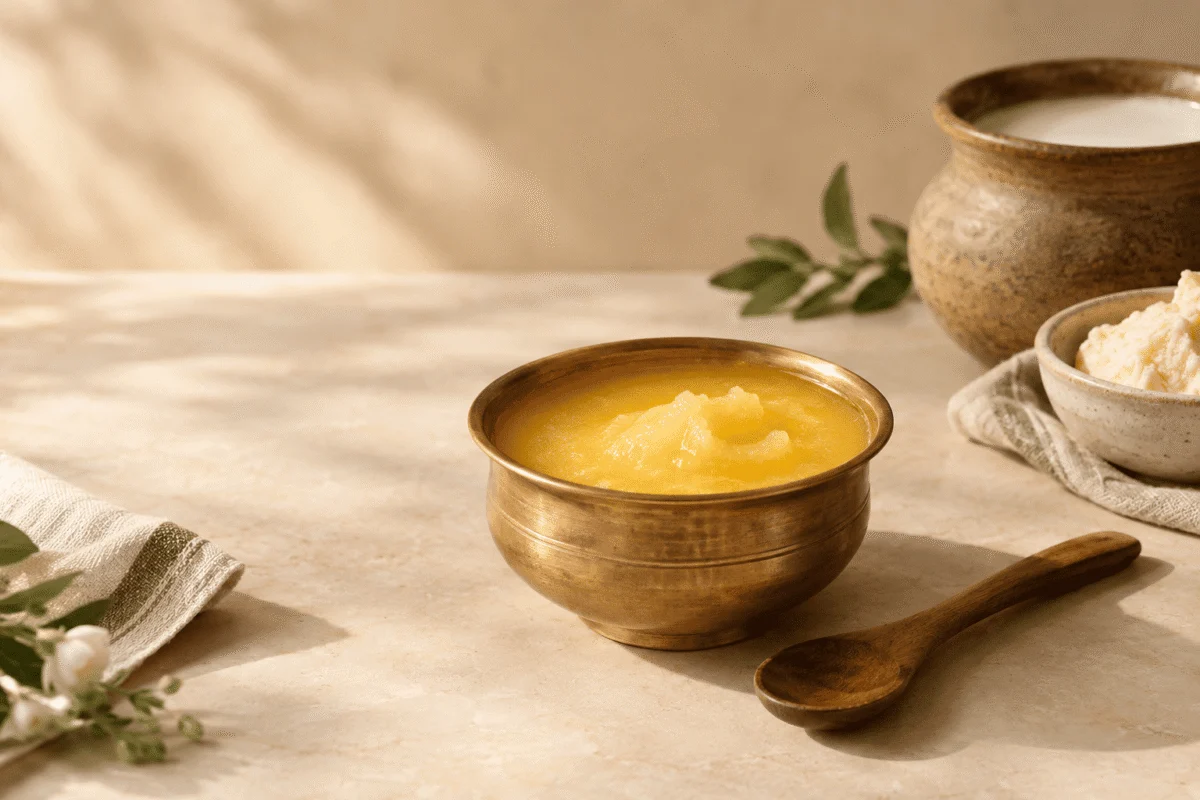
There is something quietly comforting about a little ghee.
The aroma of घृत (ghee) melting over warm खिचड़ी (khichdi).
A golden spoonful stirred into दाल (dal).
The familiar sound of a तड़का (tempering) coming together in a warm kitchen.
For many of us, ghee is not a new wellness discovery.
It is something we grew up seeing on the dining table.
And yet, somewhere along the way, we started questioning it.
Is it too rich?
Is it good for the body?
Should we avoid it?
Or is the recent enthusiasm around ghee simply another wellness trend?
Ayurveda offers a rather beautiful answer.
घृत (ghee) has been valued for centuries — not because it was fashionable, but because the classical Ayurvedic physicians observed its qualities, its effects and the ways in which it could be used.
In the classical texts, ghee is not simply described as a fat.
It is described as स्नेह (unctuous nourishment), a food with distinctive qualities, a substance used in rejuvenation, and a vehicle for herbal preparations.
And perhaps most importantly, Ayurveda never separated the food from the person eating it.
That is where the real wisdom begins.
घृत (Ghee): A Food With a Special Place in Ayurveda
In the classical Ayurvedic tradition, घृत (ghee) holds an unusually important position.
चरक संहिता (Charaka Samhita) describes it as the foremost among the स्नेह (unctuous substances):
सर्वस्नेहोत्तमं घृतम्।
(Ghee is considered the foremost among the unctuous substances.)
This is not a casual description.
The Ayurvedic texts discuss four principal forms of स्नेह (unctuous substances), but घृत (ghee) receives particularly extensive attention.
Why?
Because Ayurveda considers ghee to possess a unique combination of qualities.
It is स्निग्ध (unctuous), मृदु (soft) and मधुर (sweet), and is traditionally described as शीत (cooling) in potency.
These qualities give it a distinctive place in Ayurvedic nutrition.
But there is something even more interesting.
The classical texts describe ghee as capable of taking on the qualities of substances with which it is properly processed.
This concept is known as संस्कार (processing/transformation).
It is one of the reasons ghee became such an important base for Ayurvedic herbal preparations.
What Did Charaka Samhita See in Ghee?
If we open चरक संहिता (Charaka Samhita), the description becomes much more interesting than the simple question of whether ghee is “healthy.”
Charaka associates घृत (ghee) with:
स्मृति (memory)
बुद्धि (intellect)
अग्नि (digestive fire)
ओजस् (vital essence)
बल (strength)
शुक्र (reproductive vitality)
and describes it as particularly useful in relation to वात (Vata) and पित्त (Pitta).
This tells us something fundamental about Ayurvedic thinking.
The ancient physicians were not asking:
“Does this food have fewer calories?”
They were asking:
“What qualities does this food bring into the body?”
Is it drying or unctuous?
Heavy or light?
Heating or cooling?
Does it support or disturb अग्नि (digestive fire)?
Which दोष (dosha) does it nourish or pacify?
How does it behave when combined with other substances?
This way of thinking makes food deeply personal.
Ghee and अग्नि (Digestive Fire)
One of the most fascinating traditional descriptions of ghee is its relationship with अग्नि (digestive fire).
At first, this seems surprising.
Ghee is rich and nourishing. So how can it also be associated with digestion?
Ayurveda’s answer lies in गुण (qualities) and मात्रा (quantity).
The classical texts describe ghee as capable of supporting अग्नि (digestive fire) when appropriately used.
But this should never be interpreted as:
“The more ghee you eat, the stronger your digestion will become.”
That is not the Ayurvedic approach.
Imagine a small flame.
A little appropriate fuel can keep it burning beautifully.
Too much can overwhelm it.
The same principle applies to food.
Ghee may be nourishing for someone with the right digestive capacity, while excessive amounts may feel heavy for someone whose अग्नि (digestive fire) is already sluggish.
Ayurveda is not simply about what you eat. It is about how your body receives what you eat.
Why Ghee Is Traditionally Associated With Vata and Pitta
Ayurveda describes घृत (ghee) as particularly supportive in conditions associated with aggravated वात (Vata) and पित्त (Pitta).
Think about the qualities of these doshas.
वात (Vata) is associated with movement, dryness, lightness and irregularity.
पित्त (Pitta) is associated with heat, intensity and transformation.
Ghee brings qualities that are traditionally considered:
स्निग्ध (unctuous)
मृदु (soft)
शीत (cooling)
मधुर (sweet)
These qualities help explain why ghee has traditionally been valued in Ayurvedic approaches to Vata- and Pitta-related imbalance.
But this is precisely why Ayurveda does not recommend one fixed quantity for everyone.
Your प्रकृति (constitution) matters.
Your अग्नि (digestive capacity) matters.
The season matters.
Your current state matters.
And so does the rest of your diet.
Ghee and the Mind: A Forgotten Part of the Tradition
Perhaps one of the most beautiful things about the classical description of ghee is that its story does not end with the stomach.
Charaka associates ghee with स्मृति (memory) and बुद्धि (intellect).
अष्टाङ्गहृदय (Ashtanga Hridaya) similarly describes ghee in relation to धी (understanding), स्मृति (memory) and मेधा (intellectual capacity).
The classical verse states:
शस्तं धी-स्मृति-मेधाग्नि-बलायुः-शुक्र-चक्षुषाम्।
(Ghee is traditionally described as beneficial for understanding, memory, intellect, digestive fire, strength, longevity, reproductive vitality and vision.)
There is something deeply holistic about this description.
The Ayurvedic physicians did not draw a rigid line between physical nourishment and mental nourishment.
A nourished body, healthy digestion and a calm mind were part of the same picture.
Perhaps that is why ghee has remained closely connected with traditional preparations intended to support the mind.
Ghee and ओजस् (Vitality)
Ayurveda speaks often of ओजस् (vital essence).
It is one of those concepts that cannot be reduced to a single modern word.
Ojas is traditionally associated with strength, vitality, resilience and the deeper nourishment of the body.
Charaka includes ओजस् (vital essence) among the aspects associated with ghee.
This helps explain why ghee has historically been included in nourishing diets and रसायन (rejuvenative) practices.
The traditional idea is not that one spoonful of ghee magically creates vitality.
It is subtler.
When food is properly digested and the tissues are adequately nourished, Ayurveda considers this part of the foundation for बल (strength) and ओजस् (vitality).
Ghee became one of the foods associated with that nourishment.
Ghee and Healthy Ageing
Long before the modern fascination with “anti-ageing,” Ayurveda was concerned with something deeper:
How do we preserve strength, vitality and clarity as we grow older?
This is the realm of रसायन (rejuvenative nourishment).
अष्टाङ्गहृदय (Ashtanga Hridaya) describes ghee in connection with maintaining the qualities of youth and longevity.
The classical text uses the expression:
वयस्यः स्थापनं परम्।
(It is regarded as highly supportive of maintaining youthful qualities and longevity.)
This is not about chasing youth.
It is about preserving बल (strength), मेधा (intellectual capacity), ओजस् (vitality) and the ability to live well as the years pass.
That distinction feels particularly relevant today.
Why Ayurvedic Physicians Put Herbs Into Ghee
This is perhaps one of the most fascinating parts of the story.
Walk into an Ayurvedic pharmacy and you will find preparations such as ब्रह्मी घृत (Brahmi Ghrita), महातिक्त घृत (Mahatiktaka Ghrita) and many other घृत (ghee-based) formulations.
Why ghee?
Because Ayurveda considers it an excellent medium for processing herbs.
Charaka describes the principle of संस्कार (processing) — that ghee can acquire qualities associated with substances processed with it while retaining its fundamental nature.
This allowed physicians to create preparations with very specific purposes.
The ghee itself was important.
But so was the herb.
And so was the method of preparation.
This is why classical Ayurveda contains hundreds of different formulations involving घृत (ghee).
It was not simply a cooking ingredient.
It was part of the Ayurvedic pharmacopeia.
Purana Ghrita: The Tradition of Aged Ghee
There is another fascinating detail hidden in the classical texts.
Ayurveda distinguishes between fresh ghee and पुराण घृत (aged ghee).
Classical texts describe ghee that has been stored for extended periods as having different properties from freshly prepared ghee.
अष्टाङ्गहृदय (Ashtanga Hridaya) describes पुराण घृत (aged ghee) in relation to specific therapeutic applications, including traditional wound-related uses.
This may sound unusual to a modern reader.
But it reveals something important about Ayurveda:
The tradition was never simplistic.
It paid attention to age, preparation, processing, combinations and purpose.
“Ghee” was not necessarily treated as one identical substance in every situation.
So… Should You Eat Ghee?
Now we can return to the question that brought us here.
Is ghee actually healthy?
From the perspective of classical Ayurveda:
Yes. Ghee is considered a highly nourishing and beneficial food when it is appropriate for the individual and used in the right quantity.
The classical texts repeatedly associate it with:
अग्नि (digestive fire)
स्मृति (memory)
बुद्धि (intellect)
मेधा (intellectual capacity)
बल (strength)
ओजस् (vitality)
आयु (longevity)
शुक्र (reproductive vitality)
चक्षुस् (vision)
and with the traditional balancing of वात (Vata) and पित्त (Pitta).
That is a remarkably positive description.
But there is one word that Ayurveda would never want us to forget:
मात्रा (quantity).
The Wisdom Is in the Amount
Ghee is nourishing.
But nourishment is not the same thing as excess.
The classical Ayurvedic approach is always contextual.
A person’s प्रकृति (constitution), अग्नि (digestive capacity), age, season, activity, current imbalance and overall diet all influence what is appropriate.
This is why the popular modern ritual of taking large amounts of ghee simply because it is considered “healthy” is not particularly Ayurvedic.
Ayurveda does not worship ingredients.
It understands them.
There is a beautiful difference.
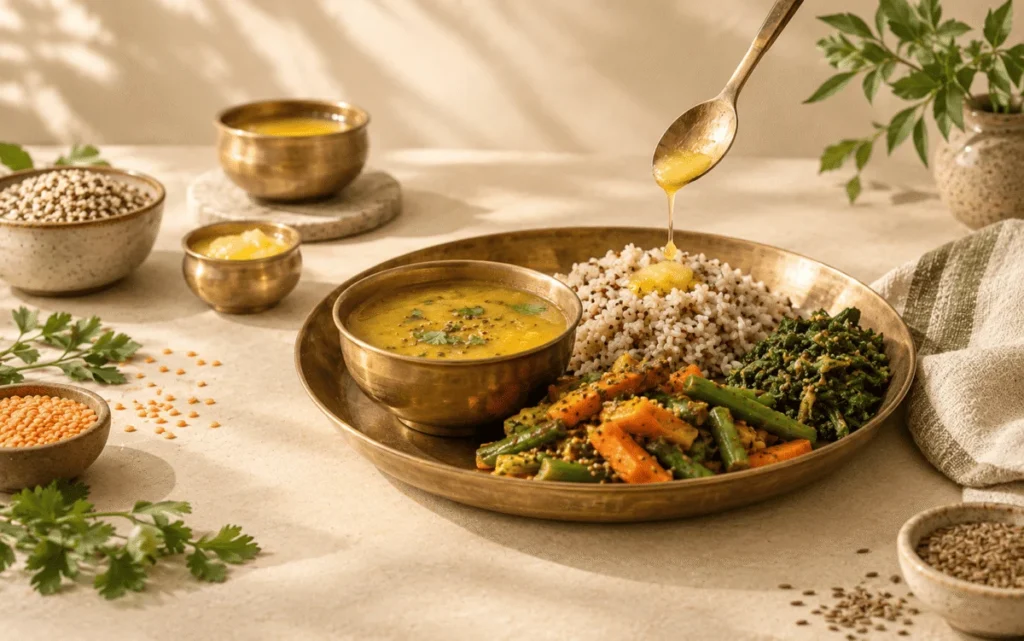
How Ghee Can Belong on Your Plate
You don’t need to turn ghee into a ritual.
Sometimes its most traditional use is also its simplest.
A little ghee over warm खिचड़ी (khichdi).
A small spoonful with दाल (dal).
Ghee used for तड़का (tempering).
A little stirred into warm grains or vegetables.
The idea is not to make the meal excessively rich.
It is to bring स्नेह (unctuous nourishment) into a wholesome meal.
And there is something deeply human about this.
Our grandmothers may not have spoken about fatty-acid profiles or nutrient density.
They simply knew that a little ghee could make a meal feel complete.
Ayurveda gave language and theory to many of those observations.
Perhaps We Asked the Wrong Question
For years, we have asked:
“Is ghee good or bad?”
But Ayurveda rarely sees food in such absolute terms.
The better questions are:
Is it right for me?
Is my digestion ready for it?
How much do I need?
What am I eating it with?
What season am I in?
What does my body need right now?
That is a much more intelligent way to think about food.
And perhaps this is why the wisdom of Ayurveda continues to feel relevant.
It doesn’t ask us to fear food.
It asks us to understand food.
The Ananta Harmony Perspective
Ghee does not need to be turned into a miracle food.
And it does not need to be feared.
It has already earned its place in Ayurveda.
For centuries, चरक (Charaka), सुश्रुत (Sushruta) and वाग्भट (Vagbhata) wrote about घृत (ghee) as a substance of nourishment, strength, vitality and therapeutic value.
They described its relationship with अग्नि (digestive fire), ओजस् (vitality), मेधा (intellect), स्मृति (memory), बल (strength) and आयु (longevity).
But they also gave us something more important than a list of benefits.
They gave us context.
Ghee is not meant to be consumed simply because someone on the internet said it is good.
It is meant to be understood according to मात्रा (quantity), अग्नि (digestion), प्रकृति (constitution), काल (time/season) and the needs of the individual.
Perhaps that is the real Ayurvedic wisdom behind ghee.
Not more.
Not less.
Just right.
A little golden spoonful on a warm meal.
A tradition carried quietly from one generation to another.
And a reminder that sometimes, the oldest wisdom does not need to be reinvented.
It simply needs to be understood.
Balance. Heal. Thrive.
A note on the classical tradition
The descriptions in this article represent the traditional Ayurvedic understanding of घृत (ghee) found in classical texts including चरक संहिता (Charaka Samhita), सुश्रुत संहिता (Sushruta Samhita) and अष्टाङ्गहृदय (Ashtanga Hridaya).
References to therapeutic घृत (ghee) in these texts often concern specific formulations, preparation methods, quantities and clinical contexts. They should not be interpreted as a recommendation to use medicated ghee for treating a medical condition without appropriate professional guidance.
Ananta Harmony believes traditional knowledge deserves to be preserved with its context, depth and humanity — not reduced to a modern “superfood” label.
Balance. Heal. Thrive.
Classical references
चरक संहिता (Charaka Samhita) — सूत्र स्थान (Sutra Sthana), chapters discussing स्नेह (unctuous substances) and the properties and actions of घृत (ghee).
सुश्रुत संहिता (Sushruta Samhita) — सूत्र स्थान (Sutra Sthana), Chapter 45, describing the qualities and traditional applications of घृत (ghee).
अष्टाङ्गहृदय (Ashtanga Hridaya) — सूत्र स्थान (Sutra Sthana), Chapter 5, describing the traditional properties and applications of घृत (ghee).