Ayurveda, translated for modern life

Ashwagandha: The Ayurvedic Herb for Balance & Resilience
The most-studied herb in Ayurveda, and one of the most oversold. What the research supports on stress and sleep, what it does not, and who should avoid it.

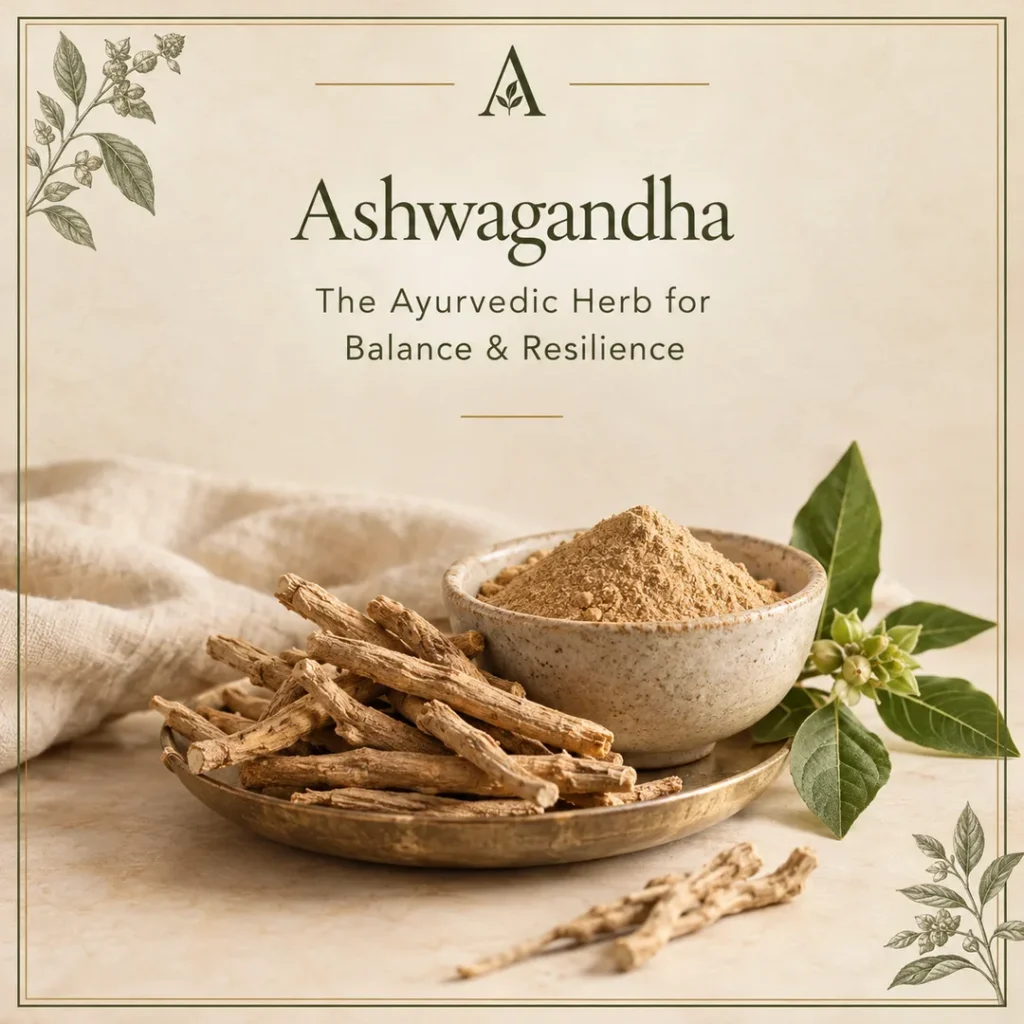
In a world of constant stimulation, demanding schedules, poor sleep, and mental overload, the idea of resilience has become increasingly relevant to modern wellness.
Long before “stress management” became part of the wellness vocabulary, Ayurveda explored ways to support the body and mind through periods of physical and emotional demand. Among the herbs traditionally valued for this purpose is Ashwagandha (Withania somnifera).
Often called Indian ginseng—although botanically unrelated to true ginseng—ashwagandha has been used in Ayurveda for centuries. Today, it has also become one of the most widely researched Ayurvedic herbs.
But its popularity raises an important question:
What can ashwagandha actually do—and where does traditional wisdom end and modern evidence begin?
What Is Ashwagandha?
Ashwagandha is a small shrub native to India and parts of Asia and Africa. Its roots are the part most commonly used in traditional preparations and modern supplements.
The Sanskrit name Ashwagandha is often associated with the words ashwa (horse) and gandha (smell), referring traditionally to the characteristic smell of the root and its association with strength and vitality.
In Ayurveda, ashwagandha is commonly classified as a Rasayana—a category of rejuvenating herbs and practices traditionally used to support vitality, strength, longevity, and overall resilience.
Rather than thinking of it simply as a “stress herb,” the Ayurvedic perspective is broader: ashwagandha has traditionally been used when nourishment, restoration and strengthening are needed.
Why Is Ashwagandha So Relevant Today?
Modern life may look very different from life centuries ago, but the human body still responds to prolonged demands.
Late nights, insufficient recovery, constant notifications, demanding work, irregular meals and emotional stress can leave us feeling as though we are always “on.”
This is one reason ashwagandha has attracted so much modern interest.
Researchers have studied it for several areas, particularly:
- perceived stress and anxiety
- sleep quality
- physical performance and recovery
- fatigue and general well-being
- certain aspects of reproductive health
However, the quality and amount of evidence varies considerably between these areas. Ashwagandha should therefore not be presented as a cure-all simply because it has a long history of traditional use.
Ashwagandha and Stress: What Does the Research Suggest?
This is perhaps the best-known modern use of ashwagandha.
Several clinical trials have investigated standardized ashwagandha extracts in adults experiencing stress. Some studies have reported improvements in measures of perceived stress and anxiety, and some have observed changes in cortisol levels.
This has led to ashwagandha frequently being described as an adaptogen.
Adaptogens are generally described in modern herbal medicine as substances that may help the body adapt to physical or psychological stress. It is worth remembering, however, that “adaptogen” is a modern herbal concept rather than a traditional Ayurvedic classification.
Current evidence is promising, but studies often differ in the extract used, dosage, duration and participant population.
So rather than saying:
“Ashwagandha lowers cortisol.”
A more accurate interpretation is:
Certain ashwagandha preparations may help support stress management in some people, but the effects cannot be assumed to be identical for every person or every supplement.
Can Ashwagandha Support Better Sleep?
Stress and sleep are closely connected.
When the mind remains active late into the evening, falling asleep—or waking feeling genuinely restored—can become difficult.
Ashwagandha has been investigated for its potential effects on sleep. Some clinical research suggests that certain extracts may produce modest improvements in aspects of sleep quality, particularly in people experiencing sleep difficulties.
This does not make ashwagandha a sleeping pill.
Instead, its potential role may be better understood as part of a broader approach to recovery.
Regular sleep timing, morning daylight exposure, movement, balanced meals, reduced evening stimulation and sufficient time for rest remain far more foundational than any single herb.
Ayurveda was never meant to be reduced to supplements.
Ashwagandha, Energy and Physical Resilience
One interesting feature of ashwagandha is that it is not traditionally thought of simply as something “calming.”
Ayurveda has long associated the herb with strength, nourishment and restoration.
Modern research has explored whether supplementation may influence exercise performance, muscle strength and recovery. Some studies have reported improvements in measures such as strength or aerobic capacity, but research remains limited and results depend on the population and preparation studied.
This distinction matters.
Feeling depleted does not automatically mean that you “need ashwagandha.”
Low energy can have many causes—from inadequate sleep and insufficient nutrition to iron deficiency, thyroid disorders or other health conditions. Persistent fatigue deserves proper evaluation rather than simply adding another supplement.
What About Ashwagandha and Hormones?
This is where wellness claims often become exaggerated.
Social media sometimes describes ashwagandha as a herb that can simply “balance your hormones.”
Human physiology is far more complicated.
Hormones operate through interconnected systems involving the brain, thyroid, adrenal glands, ovaries or testes, pancreas and many other tissues.
There is some research examining ashwagandha in areas including stress-related physiology, testosterone, fertility and thyroid function. But that does not establish ashwagandha as a universal hormone-balancing remedy.
This is especially important because ashwagandha may influence thyroid hormone levels in some people.
Anyone with a diagnosed hormonal or thyroid condition should therefore be particularly cautious about self-supplementation.
The Ayurvedic Perspective: Who Is Ashwagandha Traditionally For?
Ayurveda does not traditionally approach herbs with the idea that:
“This herb is healthy, therefore everyone should take it.”
Instead, recommendations consider factors such as constitution (Prakriti), current imbalance (Vikriti), digestion (Agni), season, age, strength and the qualities of the herb itself.
Ashwagandha is traditionally described as nourishing, strengthening and relatively warming.
Because of these qualities, it has historically been associated with situations involving weakness, depletion or the need for restoration.
But this also explains why it may not suit everyone equally.
The Ayurvedic lesson is not that everyone needs ashwagandha. It is that herbs should be chosen with context.
How Is Ashwagandha Traditionally Used?
Ashwagandha has traditionally been used in different preparations, including powders and formulations combined with other ingredients.
Today, consumers are more likely to encounter:
Ashwagandha root powder
Closer in form to traditional herbal use, although preparation and quantity still matter.
Standardized extracts
Frequently used in clinical studies and supplements because specific constituents can be concentrated and standardized.
Capsules or tablets
Convenient, but their potency varies considerably between brands.
Herbal formulations
Ayurvedic preparations may combine ashwagandha with other ingredients depending on their intended purpose.
This is why comparing two products simply by the number of milligrams on the label can be misleading. A concentrated extract is not necessarily equivalent to the same quantity of powdered root.
More Is Not Better
One of the biggest problems with the modern wellness industry is the assumption that natural products are automatically harmless.
They aren’t.
Ashwagandha can cause side effects, including gastrointestinal upset, nausea, loose stools or drowsiness in some people.
More importantly, rare cases of liver injury associated with ashwagandha supplements have been reported.
Ashwagandha may also interact with medications or affect physiological systems including thyroid function, blood pressure, blood glucose and immune activity.
Quality matters too. Herbal supplements can differ substantially in their ingredients, concentration and manufacturing standards.
Who Should Be Particularly Careful?
Ashwagandha should not be casually added to everyone’s daily routine.
Pregnant people should avoid ashwagandha unless specifically directed by an appropriately qualified healthcare professional. Caution is also warranted during breastfeeding because safety information is limited.
Medical guidance is particularly important for people who:
- have thyroid disease
- have liver disease or a history of liver problems
- have autoimmune conditions
- take medications for blood pressure or diabetes
- use sedative medications
- use thyroid medication
- use immunosuppressive medicines
- are preparing for surgery
- are undergoing fertility treatment or treatment for another medical condition
If you take regular medication or have a diagnosed condition, discuss supplementation with your doctor or another appropriately qualified healthcare professional. If you would like guidance on whether ashwagandha suits your constitution, Dr. Arun offers consultations.
The Bigger Lesson Ashwagandha Can Teach Us
Perhaps the most valuable thing about ashwagandha isn’t found inside a capsule.
It is the philosophy surrounding it.
Ayurveda reminds us that resilience is built through nourishment and recovery—not simply by pushing ourselves harder.
An herb cannot compensate indefinitely for five hours of sleep.
A supplement cannot replace sufficient food.
A powder cannot undo chronic overwork.
And no “adaptogen” eliminates the need to understand why the body feels depleted in the first place.
Ashwagandha may have a useful role for certain people. But it works best conceptually within a much larger foundation:
Sleep. Nourishment. Movement. Rest. Routine. Connection. Recovery.
The herb should complement those foundations rather than replace them.
Traditional Wisdom, Modern Perspective
Ashwagandha offers an interesting meeting point between classical Ayurvedic knowledge and modern scientific investigation.
Its traditional reputation as a strengthening and rejuvenating herb has encouraged researchers to investigate its potential effects on stress, sleep, physical performance and other aspects of health.
Some findings are encouraging.
But encouraging evidence is not the same as proof that everyone should take it.
The more thoughtful approach is also the more Ayurvedic one: understand the person, understand the context and then consider the herb.
At Ananta Harmony, we believe traditional wisdom becomes more valuable—not less—when it is approached with curiosity, context and respect for modern evidence.
Because wellness isn’t about collecting more supplements.
It is about learning to understand what your body truly needs.
Balance. Heal. Thrive.
This article is for educational purposes only and is not intended to diagnose, treat, cure or prevent any disease. Herbal supplements can cause side effects and interact with medications. Seek professional medical advice when appropriate, particularly during pregnancy or breastfeeding or if you have a medical condition or take medication.